
Maritime Law · Turkish Commercial Code arts. 1247–1271
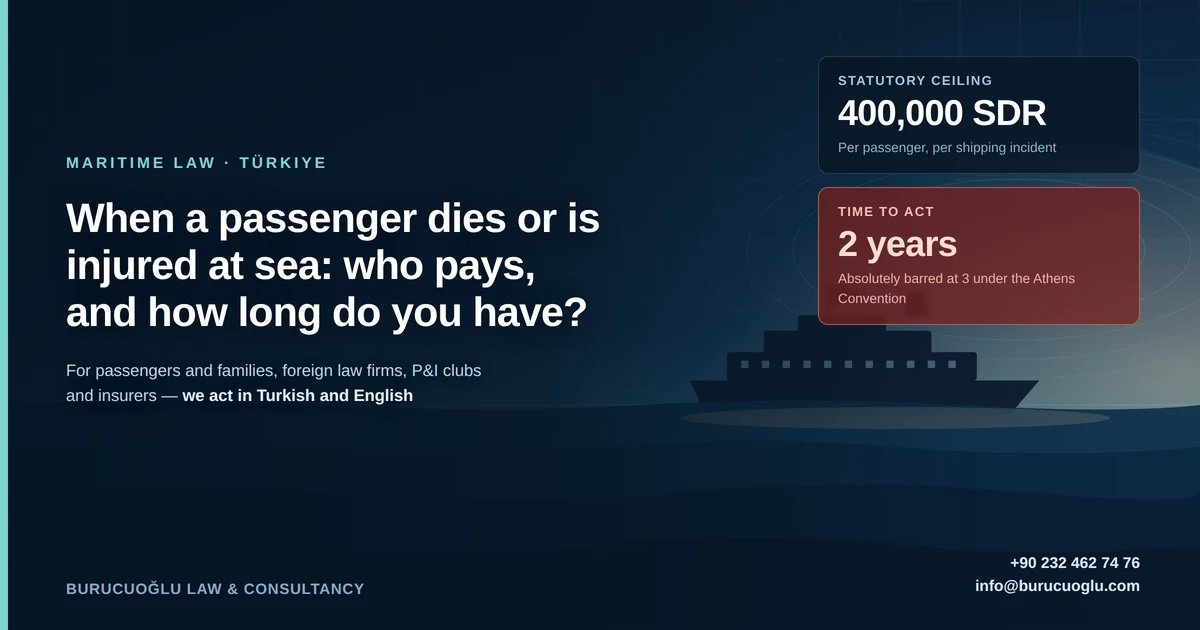
If a passenger dies or is injured in a shipping incident on a voyage governed by Turkish law, the carrier is liable up to 250,000 SDR per passenger without you having to prove fault — and up to 400,000 SDR unless the carrier proves it was not at fault.
Turkey applies this regime under Articles 1247 to 1271 of the Turkish Commercial Code (Law No. 6102) and, since 16 September 2022, under the 2002 Protocol to the Athens Convention.[1]
The distinction that decides most of these claims is not the size of the limit. It is whether the loss arose from a shipping incident — because that single question moves the burden of proof from one side of the courtroom to the other. What follows sets out how the regime works, what the carrier must prove, when the limits fall away, and the deadline that catches claimants out.
Which law applies to a passenger claim in Turkey?
Two instruments operate together.
The Turkish Commercial Code governs the contract for the carriage of passengers by sea. Its provisions were drafted to mirror the 2002 Athens Convention, so the substantive rules and the monetary limits align closely. TCC arts. 1247–1271
The 2002 Protocol to the Athens Convention (PAL 2002) entered into force for Türkiye on 16 September 2022. Turkey approved it by Law No. 6990 and by Presidential Decision No. 1580, depositing its instrument of accession on 16 June 2022. Turkey entered a reservation limiting Article 11 on recognition and enforcement of judgments to states it recognises and with which it has diplomatic relations.[2]
Which instrument governs a given claim depends on whether the carriage falls within the Convention’s international scope. For purely domestic Turkish carriage, the Commercial Code applies directly. The practical consequence appears under Time limits below, where the two do not say the same thing.
Working out which regime governs your claim? The answer turns on the vessel’s flag, the route, where the contract was made and the terms of the ticket. This office advises on passenger claims under Turkish law. Call +90 232 462 74 76 or email info@burucuoglu.com.
Shipping incident or not? The question that decides the case
Article 1256 creates two separate liability regimes for death and personal injury, and allocates the burden of proof differently in each.
Article 1256(5)(a) defines a shipping incident as the wreck, capsizing, stranding or grounding of the ship, collision, explosion or fire on board, or a defect in the ship.
That last category is broader than it first appears. Article 1256(5)(c) defines a defect in the ship as any malfunction or non-compliance with safety rules in the parts or equipment used in abandoning or evacuating the ship; embarkation and disembarkation; propulsion, steering, safe navigation, mooring, anchoring, arriving at or leaving a berth; damage control in the event of flooding; and the launching of life-saving appliances.
So a failure of the evacuation or life-saving equipment is not merely evidence of fault. It converts the event into a shipping incident and shifts the burden of proof onto the carrier.
What can the carrier say in its defence?
Within the first tier of 250,000 SDR, the carrier escapes liability only by proving that the incident resulted from one of the following. TCC art. 1256(1)
- War, terrorism, civil war or insurrection.
- A natural phenomenon of an exceptional, inevitable and irresistible character.
- An act or omission of a third party done wholly with intent to cause the incident.
The threshold is deliberately high. Ordinary bad weather is not exceptional, inevitable and irresistible. Negligence by a third party is not enough either — the third party’s act must have been intentional.
Between 250,000 and 400,000 SDR the carrier is liable unless it proves it was not at fault. Its fault includes the fault of its servants and agents acting within the scope of their duties, so the conduct of the master and crew is attributed to the carrier. TCC art. 1256(5)(b)
You retain one burden throughout: proving that the incident occurred during the carriage, and proving the extent of the loss. The period of carriage runs from embarkation to disembarkation and generally excludes time spent in a passenger terminal, on a quay or at another port facility. It does extend to transfer by water between shore and ship where the cost is included in the fare or the craft was placed at your disposal by the carrier — which matters where passengers are moved by tender. TCC arts. 1256(7), 1258
When does the carrier lose the right to limit?
Article 1267 removes the benefit of the limits altogether where the loss is proved to have resulted from an act or omission of the carrier committed with intent to cause such loss, or recklessly and with knowledge that such loss would probably result.
This is the familiar international formula, and it is demanding. Ordinary negligence — even serious negligence — does not meet it. What is required is a conscious appreciation of the probable consequence. The same test applies to the carrier’s servants and agents. Where it is met, the claim is uncapped and assessment reverts to the ordinary Turkish law of damages.
Two further points are easily overlooked. Interest and litigation costs fall outside the limits — the ceiling applies to the substantive award, not to total recovery. And the carrier and passenger may expressly and in writing agree higher limits; it is only reductions that the Code forbids. TCC arts. 1264(1)–(2), 1271
Compulsory insurance: who actually pays
Every carrier and performing carrier operating a ship licensed to carry more than twelve passengers must maintain insurance against liability for passenger death and personal injury. The minimum cover was amended by Law No. 7519 on 4 July 2024:
A ship that does not meet these requirements shall not be permitted to sail. Establish the insurance position early: it determines whether there is a solvent respondent behind the carrier, and the licence category tells you which minimum applies. TCC art. 1259
Time limits — and the trap
The Commercial Code sets two periods. TCC art. 1270
Periods may be extended after the claim has arisen, by written declaration of the carrier or written agreement of the parties.
The ten-year period is not a safe assumption. Article 16 of the Athens Convention sets a two-year period and — critically — an absolute three-year longstop running from disembarkation or the date disembarkation should have taken place, after which no claim may be brought at all.
Since the 2002 Protocol entered into force for Türkiye on 16 September 2022 the two instruments have coexisted. Which period governs a claim arising from international carriage is to be analysed on the facts of each case, not assumed. The asymmetry is not academic: a claimant relying on ten years may find the claim absolutely barred at three. Where there is any doubt, treat the shorter period as the operative deadline and bring the claim well within two years.
Ticket terms that do not bind you
Article 1271 is one of the most useful provisions in the chapter for a foreign passenger, and one of the least known.
Any contractual term agreed before the incident which excludes the liability of a person liable under the chapter, reduces the statutory limits, or reverses the burden of proof resting on the carrier is void. The invalidity of the clause does not invalidate the contract of carriage itself.
It goes further: jurisdiction and arbitration agreements concluded before the claim arose are invalid. A forum-selection or arbitration clause printed on a ticket and accepted at the point of purchase will not on its face bind you. Carriers and their insurers do not always raise this, and passengers frequently assume such a clause binds them when it does not. An agreement reached after the claim has arisen is a different matter.
Who is the right defendant?
Identify the carrier
The person by whom, or on whose behalf, the contract of carriage was concluded — often a ticketing or tour entity that never operates the ship. TCC art. 1248
Identify the performing carrier
A different person who, as owner, charterer or operator of the ship, actually performs all or part of the carriage.
Note that both remain on the hook
The carrier remains liable for the whole of the carriage even where performance was entrusted to a performing carrier, and is answerable for that carrier’s fault. Where both are liable, their liability is joint and several — you may pursue either for the full amount and leave them to their rights of recourse. TCC art. 1257
Expect servants to invoke the same defences
Servants and agents sued directly may rely on the carrier’s defences and limits if they prove they acted within the scope of their duties. The aggregate recoverable from carrier, performing carrier and servants together cannot exceed the highest single amount for which any of them could be held liable. TCC arts. 1265–1266
Identifying the correct respondents at the outset matters, because a claim brought against the wrong entity can run into the limitation period while it is being corrected.
Luggage and vehicles
The parties may agree a deductible not exceeding 330 SDR per vehicle and 149 SDR per passenger for other luggage. Money, negotiable instruments, gold, silver, jewellery, works of art and other valuables fall outside the carrier’s liability altogether unless deposited with the carrier for safekeeping. TCC arts. 1260, 1263
Frequently asked questions
What is a Special Drawing Right, and what is it worth?
The SDR is a unit of account maintained by the International Monetary Fund, based on a basket of major currencies. Its value changes daily, so limits expressed in SDR are converted at the rate applicable on the relevant date. The current rate is published by the IMF.[3]
Can a foreign passenger or a foreign family bring a claim in Turkey?
Yes. Nationality does not restrict standing. A claimant abroad will need to appoint a Turkish lawyer by power of attorney, executed either at a Turkish consulate or before a local notary with an apostille and sworn translation.
Does a clause in the ticket requiring arbitration abroad bind the passenger?
Under Article 1271(2) of the Turkish Commercial Code, jurisdiction and arbitration agreements concluded before the claim arose are invalid. An agreement reached after the claim has arisen is a different matter.
Does the carrier’s liability cover psychiatric injury or bereavement?
Article 1256 addresses death and personal injury; the heads of recoverable loss and their assessment are governed by general Turkish law. Article 1256(5)(d) expressly excludes punitive or exemplary damages from the concept of damage.
Does this regime apply to an accident on a ship outside Turkish waters?
Not automatically. The applicable law depends on the ship’s flag, the route, where the contract of carriage was concluded and the conflict-of-laws rules engaged. Turkish law is not the default answer for an incident occurring outside Turkish waters, and the analysis must be done before any claim is formulated.
Is a hovercraft passenger covered?
No. Article 1247(3) expressly excludes the carriage of passengers by air-cushion vehicles from this chapter.
Discuss a passenger claim
This office advises on passenger death and injury claims, carrier and performing carrier liability, and marine insurance matters under Turkish law, working with passengers and their families, foreign law firms, P&I clubs and insurers. We aim to respond to enquiries within one business day. Correspondence in Turkish and English.
Sources
- Turkish Commercial Code, Law No. 6102, Articles 1247–1271. Official text: mevzuat.gov.tr. Accessed 30 August 2026.
- Protocol of 2002 to the Athens Convention relating to the Carriage of Passengers and their Luggage by Sea, 1974. Approved by Law No. 6990 (Official Gazette, 3 April 2017, No. 30027) and Presidential Decision No. 1580 (Official Gazette, 19 September 2019, No. 30893 bis). Instrument of accession deposited 16 June 2022; in force for Türkiye 16 September 2022.
- International Monetary Fund, SDR Valuation.
- Article 1259 as amended by Law No. 7519, 4 July 2024, Article 20.
This article is provided for general information purposes only and does not constitute legal advice. It addresses Turkish law only and does not express any opinion on the law of any other jurisdiction. It does not create an attorney-client relationship. Turkish law and administrative practice change frequently; the position described here reflects the law as of 30 August 2026. For advice on your specific situation, please seek professional legal assistance.
Last reviewed: 30 August 2026